Source of Funds for Crypto: What Exchanges Accept as Proof
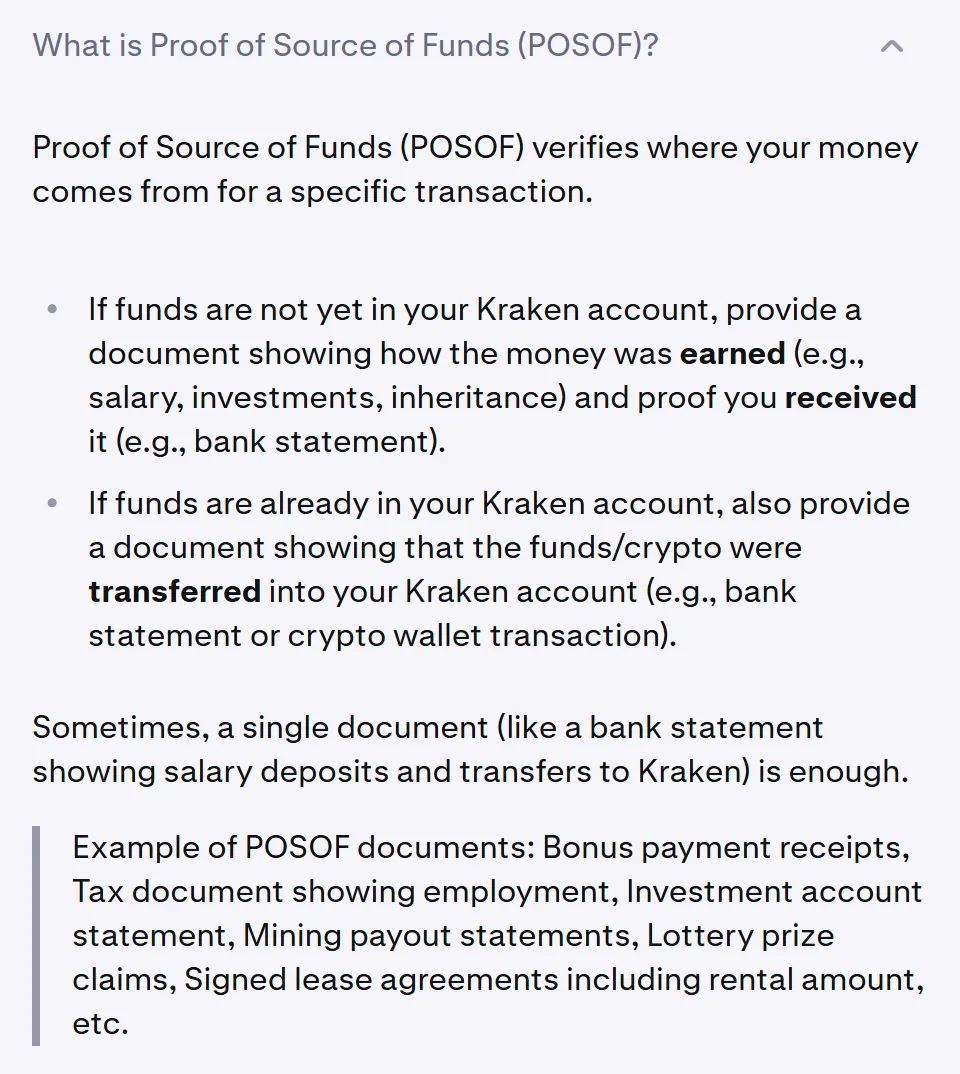
Exchanges want a trail with no gaps: a document showing how the money was earned, and a record of it reaching you and then your exchange account. Sometimes one bank statement shows both.
Jump to a section
For pay, savings, a sale, a loan, a gift or an inheritance, the trail is usually the paper behind the money (a payslip, tax return, sale contract, loan agreement, will or gift letter) plus a bank statement where it lands. For crypto, add statements or exports from the platform where you held it, the wallet addresses you used and the transaction records that end at your deposit, with proof of whatever paid for the crypto in the first place.
| Binance | Bybit | OKX | Kraken | Bitget | |
|---|---|---|---|---|---|
| How recent | Most within the last 3 months; tax statements the most recent one | Bank statement no older than 3 consecutive months; the 3 most recent consecutive payslips | Generally 6 months for EEA accounts, 3 months for others; event documents may differ | Dated within 24 months, “but exceptions apply” | No window given for these; “Documents older than 3 months” is a listed rejection reason |
| Pay | Payslip, bank statement showing salary, or tax statement | Payslips, bank statement, employment contract | Payslips, bank statement with salary credits, salary certificate, employment letter | Payslips or payroll stubs; statement showing salary deposits | Pay slips, bank statements, tax documents |
| Selling something | Real estate: sale contract, closing statement or tax statement | Sale agreement naming both parties, the asset, price and payment method | Sale agreement, invoice, receipt or legal letter, and proof you received the money | “Investments/Liquidation of an asset”, no detail given | Asset sale agreements |
| Loan | Loan agreement or bank statement; a private loan needs both | Signed agreement with amount, purpose and repayment terms | Signed agreement or account statement, and proof you received it | Not on its list | Loan statements |
| Gift or inheritance | Signed allowance letter for family support; will, tax statement or executor’s letter | Inheritance documents signed by the executor, notary or solicitor | Gift: transfer record and a declaration. Inheritance: will, probate or similar, and proof of receipt | Legal document transferring inherited assets | Written proof of a gift; probate, will or inheritance documents |
| Crypto from elsewhere | Statements or receipts of the sale and a tax or bank statement | Trading history from the platform; may ask for your wallet addresses | Proof you own the account or wallet, with history showing the transfer | Exchange statement with name, email, wallet address and balance, plus the original source | No crypto document named; investment account statements |
| Files | Types not listed on its due diligence page | Complete and unedited; full statements, not partial screenshots | Unlocked original PDF, scan or clear photo | PDF, PNG, JPG, JPEG, DOC, DOCX; screenshots if readable | JPG, PNG, PDF; split files over 20MB |
| Review time | Allow 3 to 10 business days; resubmissions can extend it | Up to 5 business days | None given | None given | None given |
Crypto that came from another exchange, a wallet or mining
Crypto you bring in from elsewhere needs the same trail, only longer. Between them, the exchanges that cover it ask where it sat before, how it moved and what paid for it, so expect to pair a statement from the other platform with a document showing the original source of the money that bought the crypto. If you bought crypto from another person with your own money, the source to prove is that money.
Start from the deposit and work back:
- The transfer into the account that’s asking. Give the platform name, the name, email address or phone number on that account, the wallet address, the transaction ID (TxID), the asset, the amount and the date. Don’t rely on the TxID alone, because it may not prove the wallet is yours or show where the assets first came from.
- Proof the sending account is yours. For an exchange account, a statement or export in your name showing your email, wallet address and balance, or a trading history that names you and the platform, covers a date range, and shows deposits, withdrawals, trades, profits and losses and the closing balance. Exchanges differ on which of the two they ask for.
- The wallet addresses you own or control. You may be asked for these, with exported history or screenshots from specific wallets or other exchanges. For a wallet you hold yourself, the list in step 1 is all you get: the page it comes from asks for evidence that you own the wallet without saying what that evidence should be.
- What first paid for the crypto. Here your income documents come back in, with the payslips, statements or sale papers behind the money that bought it.
Crypto you sold. Where the money came from selling crypto, pair statements or receipts showing the sale with a tax or bank statement showing the proceeds under your full name; at least one exchange requires both.
Mining, staking and airdrops. Expect to show the pool, dashboard, payout or on-chain record, plus evidence the assets reached your account. Equipment receipts may support a mining explanation, but they don’t replace payout and transfer records. Other lists add mining payout statements that include your name, and staking pool or wallet statements.
The blockchain may be checked too. At least one exchange says it may use blockchain analytics tools to check that your crypto comes from legitimate sources and fits the sources you declared, and may ask you to explain large or unusual deposits or withdrawals, such as those from OTC desks or DeFi protocols. Give the real addresses and amounts, untidy ones included, because they can be checked against the chain.
Bought years ago, or on a platform that has closed. Two of the date rules carry hedges: 24 months “but exceptions apply”, and event-based documents with “different validity periods”. Neither page spells out those exceptions or periods, or says what to send when the first platform’s records are gone. These lists aren’t closed, though. Kraken calls its list “just a starting point” and offers to review a document you’re unsure about, and if gathering documents is taking time, asks you to get in touch before the request expires and says it will work with you.
Tell support before the deadline rather than leaving a gap.
Money you earned, sold, borrowed or were given
For every kind of source, exchanges ask what produced the money and whether it reached you. For a sale, a loan or an inheritance, the agreement or will isn’t the whole answer: send evidence that you received the funds as well, because an unsigned agreement may not be enough. Some exchanges spell that second document out as a requirement. An older help page, from June 2023, goes further, pairing nearly every source with a bank statement and asking to see “the inbound transactions (your income) as well as the outbound transactions” to the exchange.
If your pay lands in the same account you fund the exchange from, we’d send that statement first, because one of the five says a single bank statement showing both your salary deposits and your transfers to the exchange is sometimes enough.
The harder cases:
- You own a business. Company sales, invoices and company bank statements explain what a company does, but don’t on their own show how the money became yours, and a business licence alone may not prove you received anything. Send ownership records with the dividend, salary or distribution record that carried the money to you. If you’re self-employed, the answer one list gives is your most recent tax statement, or a bank statement from the last 3 months showing income payments.
- You’re a student, or between jobs. Kraken says a request may simply be down to your situation, “such as being a student or currently unemployed”. Send documents that match where your money comes from, such as a statement showing an allowance. If you’re living on savings, a bank statement from the last 3 months showing your full name and the balance is the one to send.
- Family paid in. A gift declaration sent with the transfer record should give the amount, date, reason, frequency, the donor’s full name and their relationship to you. An allowance letter for regular support states amount and frequency and is signed by whoever provides it. Which of the two an exchange asks for varies.
- You borrowed it. A credit card statement alone may not be sufficient, and a loan whose terms prohibit using the money for digital assets or investments can’t support that activity.
Declare the source that’s true, even when another would be easier to document. Don’t pick salary unless the money is genuine employment income paid to you, and expect documents that contradict each other to be rejected. Tax returns appear on most lists as evidence only; nothing here is tax advice.
Answering a Binance source of funds request covers that exchange’s tick boxes, upload errors and review time, and the source of funds document checker lists its accepted documents for each kind of income, with “within the last 3 months” turned into a date.
What to write in the source of funds box
The form usually starts with categories such as salary, savings, business income, a loan, an asset sale, a gift or crypto moved from your own account or wallet. Pick the one closest to the money behind this deposit, not your income in general. If it takes one answer, choose the recent and main source; if it lets you tick several, tick each one that’s true and send documents for each.
Where there’s a note or background box, use it to join the documents up: what the money was, the amount, when it reached you, when you moved it to the exchange and which account it passed through. Give names and dates as your documents print them. For money that came through a company or relative, add who owned it, how it reached you and why it went into your account.
Then read the answer against your files: a selected source the documents don’t match is a listed rejection reason. A source of wealth question, if there is one, asks what built most of what you own, not where this deposit came from.
Why a genuine document comes back
The published rules that trip up real documents come down to four things.
- Dates. Three months is the usual window; the two longer ones are 6 months for EEA accounts on one exchange and 24 months on another. The table follows each exchange’s help-centre pages as we read them in October 2026, and those windows can change. If your request names a different one, go by it: the request in your account, not the help page, has the final say.
- Matching details. Your name, dates, amounts and addresses should be visible and match your account information and verified identity. Send a statement with the address on your profile; at least one list also refuses P.O. box addresses and statements with a zero balance.
- How much you hide. Mask only what’s irrelevant. Keep your name, address, account number, the issuer and the relevant transactions fully visible, because too much redaction is itself a listed reason for rejection.
- Partial pages. Send whole statements or contracts, not partial screenshots, as at least one exchange spells out. A screenshot of the deposit itself only shows that it arrived, so leave screenshots of your account deposits out.
Two exchanges list their rejection reasons, and several of them overlap with these four: a document unrelated to the source you chose, ownership that can’t be confirmed, missing pages, blurry details, a password-protected file, signs of editing, details that don’t match your account, and a date outside the window.
A returned item shows a status such as Needs update or Pending resubmission. Correct the stated issue rather than uploading the same unchanged file. If a corrected document comes back with the same reason, stop and ask support which document would meet it, quoting the message you see.
Source of funds vs source of wealth
They’re two questions, and a request can ask about both. The UK Financial Conduct Authority’s Financial Crime Guide says source of wealth “describes how a customer or beneficial owner acquired their total wealth”. Source of funds is narrower, covering “the activity that generated the funds, for example salary payments or sale proceeds, as well as the means through which” those funds were transferred, and that second half fits exchanges asking for the transfer record as well as the income.
Put more plainly, source of funds is the specific money behind a deposit, and source of wealth your overall financial background and how your wealth was built. The two may be the same, but they don’t have to be.
Say most of what you own comes from years of salary, but this deposit came from selling a car. The salary answers source of wealth, and the car sale answers source of funds. Wealth lists reach further back, to a CV or a pension award letter alongside payslips and tax documents.
The guide, written for firms the FCA regulates, says establishing both can help a firm judge whether “the level and type of transaction is consistent with” what it knows about you, and makes it a requirement for politically exposed persons. For where this check sits among the other steps, see what each KYC level asks for.
Deadlines, waiting, and whether the request is real
Open the request by logging in yourself rather than through a link in a message. Requests appear as a banner, task or prompt once you log in, and Kraken currently shows them only in a web browser, not its app. It says a genuine request “will always be visible on your account after you log in”, that a message about one you can’t see there should be treated as suspicious, and that it never asks for your password, 2FA codes or recovery phrase. If a message fails those tests, run the checks for fake KYC texts and support calls before you reply.
If your account was already verified, why exchanges re-check verified accounts explains why a request like this can arrive and the other requests that can follow.
If you miss the deadline, expect the account to be limited until the check is done. Depending on the exchange, that can cover trading, deposits or withdrawals, though Kraken says “Withdrawals are not affected.”
Review time. Only two of the pages give a figure: 3 to 10 business days on one exchange, up to 5 on another. Where no time is given, one page still says your recorded balance “will not disappear because the review is pending.” While a request shows as submitted or under review with no new action, don’t keep uploading the same files.
If you’d rather not send source of funds documents
Can I explain where the money came from in writing instead of sending documents?
Not on its own. Where the pages leave room for an explanation, it goes in with your documents: a note beside each upload, a background section for money that passed through a company, or a separate file of written answers sent alongside your proof. Whatever you write, the documents you send still have to match the information you’ve shared.
Can I cancel the deposit or withdrawal instead of answering?
Only Bybit, of the exchanges compared, describes a cancel option. It lets you cancel a deposit, withdrawal or fiat transaction held for this check from its Support Hub, but only while the status says Action required. A cancelled deposit goes back to the original payment method and a withdrawal back to your funding account, and you may be asked again the next time you make the same transaction.
Help pages compared, read in October 2026
- OKX
- Help-centre pages on source of funds requests and the documents for each source — two pages. Documents for each source, another exchange or a wallet, mining and staking, gifts, loans, company money, the 6 and 3 month windows, rejection reasons, the balance during review (published 28 August 2026, updated 15 September 2026); buying crypto from another person with your own money, screenshots of deposits (updated 11 August 2026)
- Bybit
- Help-centre pages on enhanced due diligence: what to send and how a request works — two pages, both last updated 30 March 2026. Source of funds and wealth in plain words, the document requirements, trading history, wallet addresses and blockchain analytics, matching your account details, full statements not partial screenshots, restrictions; where requests appear, statuses, the 5 business day review, cancelling a transaction held for review
- Kraken
- Support articles on source of funds documents and on answering a request for more information — two articles. Earning the money and receiving it, one statement that shows both, students and the unemployed, the 24-month window, file types, redaction, address matching, P.O. boxes and zero balances, external exchange statements and the original source, mining and staking, the list as a starting point (last updated 31 March 2025); browser-only requests, routine reviews, statuses, deadlines and asking for more time, what happens if a request expires, telling a genuine request apart (last updated 1 October 2026)
- Binance
- Help-centre guide to completing enhanced due diligence — the acceptable documents table, the two-document rows, inconsistent documents, self-employed, student and savings answers, 3 to 10 business days; updated 6 October 2026
- Bitget
- Help-centre questions and website guide on enhanced due diligence — two pages, both published 27 January 2026. Source of funds and wealth document examples, file formats, languages, redaction, screenshots, name matching, rejection reasons, restrictions after the deadline; the "Note" column at each upload step
- Crypto.com
- Help page explaining source of funds — income in and deposits out on one statement, a bank statement paired with each source, light redaction, the secure upload for written answers; dated 15 June 2023
- UK Financial Conduct Authority: FCG 3.2 Themes — the Financial Crime Guide's definitions of source of wealth and source of funds, and why firms establish them; last updated 29 November 2024