KYC Levels on Crypto Exchanges: What Each Level Unlocks, Compared
The first level is an ID document, usually with a face scan, and it opens deposits and trading. A second level, where there is one, raises withdrawal limits; source-of-funds checks come on request.
Jump to a section
| Exchange | Levels its help pages name | First level: what you send, what it opens | Higher levels: what they add | Where the limits are published | Where your account shows your level |
|---|---|---|---|---|---|
| Binance | [Verified], then [Verified Plus]; enhanced due diligence when requested | An ID document and a liveness check. Every new user needs it before depositing or trading | [Verified Plus] is proof of address. Enhanced due diligence is a politically exposed person declaration plus source of funds and wealth | No figures on the help pages, which point you to the [Identification] page in your account | Website: hover over the profile icon, click [Account], then [Identification] |
| Bybit | Standard, Advanced, Pro | Identity assessment and an ID document. Deposits, trading and P2P; withdrawals up to 1 million USDT a day without VIP status | Advanced is proof of address, up to 2 million USDT a day. Pro is enhanced due diligence, with the same limit as Advanced | A levels table in the help centre. Unverified accounts can only withdraw, up to 20,000 USDT a day and 100,000 a month | The Identity Verification page; VIP accounts raise their withdrawal limit under Account & Security |
| OKX | No numbered levels; layered checks from identity verification to enhanced due diligence | An ID photo and a live selfie or face scan. It may also ask your occupation, source of income and how you’ll use the account | Proof of address and source of funds or wealth, for accounts rated as higher risk | The 24-hour crypto withdrawal limit follows your fee tier, in its fees table | App: User center, then Profile, then Identity Verification. Website: Profile, then Verification |
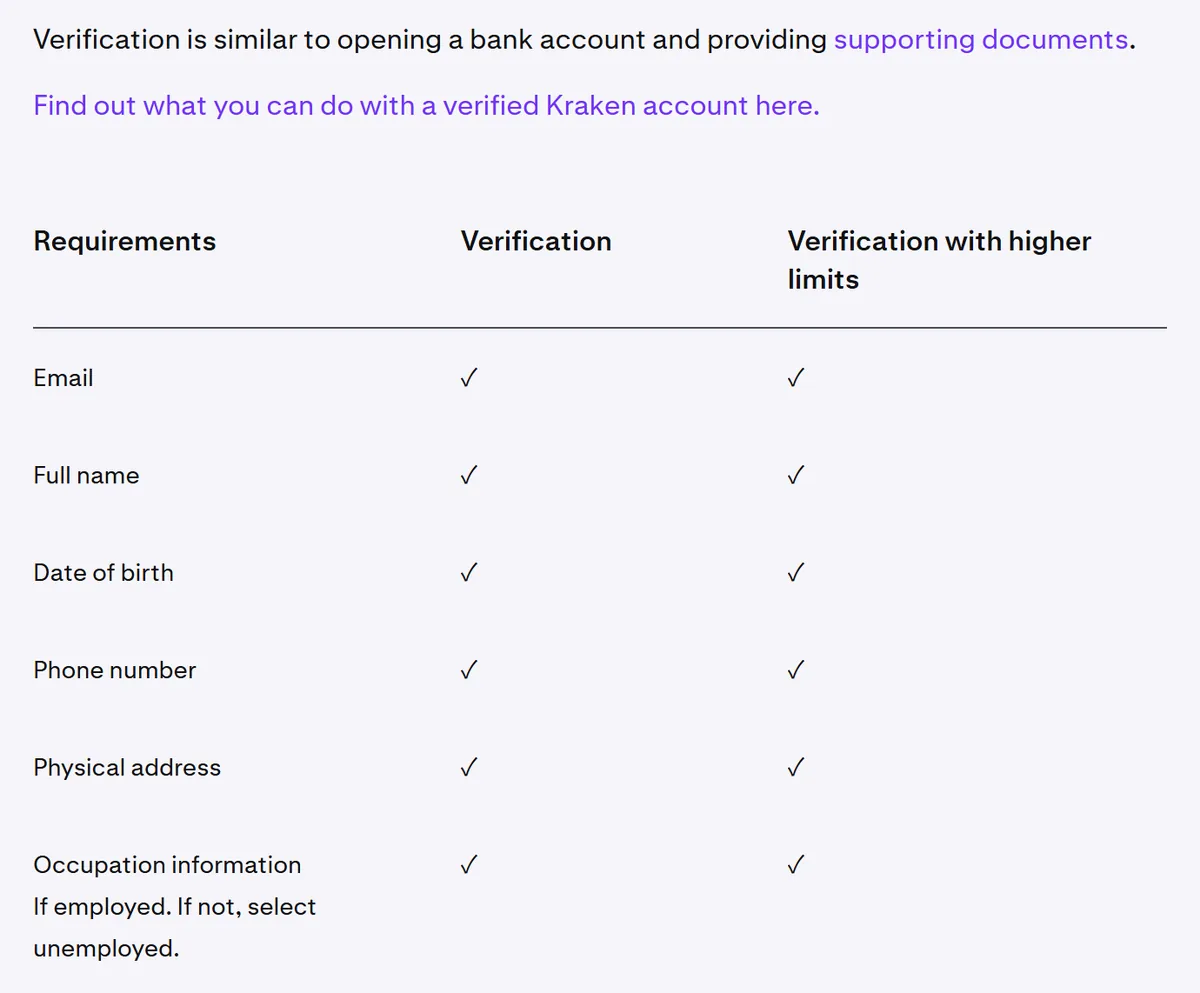
| Kraken | Verification; Verification with higher limits | Name, date of birth, phone, address, occupation and a valid ID, with proof of address or a face photo in some cases. Cash limits under $100,000 a month | A KYC questionnaire and sign-in two-factor authentication. Cash limits over $100,000 a month, and more API keys | A comparison table on its verification levels page | Pro interface: Settings, then Account, then Account details |
| Bitget | One individual verification; proof of address and enhanced due diligence on request | An ID document and a face check. Required since 1 January 2024 for crypto deposits and trading | Proof of address, asked of some users; enhanced due diligence for higher-risk accounts | By VIP level: 3 million USDT per 24 hours at VIP 0, on a page from April 2024 that sends you to the fees page for current figures | User Center, then Identity Verification; the status shows at the top of the page |
| MEXC | Primary, Advanced | A photo of the document. Crypto withdrawals up to 80 BTC a day; fiat only through P2P | The document again plus facial recognition. Up to 200 BTC a day; fiat up to 20,000 USD a day | A table in its KYC FAQ | Website: the user icon at the top right, then Identification. App: the user icon on the home screen opens your profile, which shows Verified once you’ve passed |
The second step depends on the exchange. Proof of address is a level you apply for on two of the six. On three others it’s a request that reaches only some accounts, and on the sixth the higher level is a face scan instead of an address document. Checks on where your money comes from sit at the top on the five exchanges whose pages describe them, and those pages present them as something the exchange asks of you rather than a tier you choose.
We wouldn’t line the limit figures up against each other, because they’re counted in different units. Two exchanges count in USDT a day, one in bitcoin a day, one in cash dollars a month, and two print no figure at all.
KYC level 1: what it asks for and what it opens
Expect to give your legal name, date of birth and home address, a photo of a government-issued ID, and on most exchanges a live face scan. The details vary from one exchange to the next. Not every first level includes the face scan: on one exchange the first level is a photo of the document plus your nationality and document type, and the face scan comes at the second. Occupation is a common question (choose unemployed if you aren’t working, where the form offers it).
Some exchanges also ask about your source of income and how you plan to use the account. OKX’s beginner’s guide adds that it asks for an estimate of how much you plan to deposit, as a reference point, and that you can’t change that estimate later.
For the ID itself, passports, national identity cards, driving licences and residence permits are the usual choices. Each exchange shows the list for the country you pick, and that list is the one that counts. One exchange accepts only physical documents and turns down e-copies and scans. If you don’t have a passport, the ID documents exchanges accept instead goes through the alternatives one by one.
What the first level opens is deposits and trading, and on some exchanges P2P and capped withdrawals too. On Binance, existing accounts that never completed it are switched to “Withdraw Only”, which leaves withdrawals, cancelling orders, closing positions and redemptions. One exchange publishes a cap for unverified accounts: withdrawals only, up to 20,000 USDT a day and 100,000 a month.
So an unverified account is, at most, a way to take money out. If you have funds on an exchange and haven’t finished the first level, that’s the next job.
A level can also be half done. If you skipped the face step, your withdrawal limit can stay restricted until you finish the face check or give support the missing details, and incomplete information can pause withdrawals until you provide it.
The published review times for this first check run from immediate, when the check is automated, to 48 hours, and one exchange gives no figure. Each published time is worded as usual or typical, not as a promise.
KYC level 2: usually proof of address
Proof of address is a recent document, in your name, that shows where you live. Where it sits depends on the exchange:
- A level you apply for, on two of the six. One of them processes it only after the first level is complete, and you must use the same name at both levels.
- A request for some accounts, on two more, for regulatory and compliance reasons or because the account is flagged as higher risk.
- A case-by-case extra, needed only in some situations, at either level. In some countries a face photo replaces it when the address can’t be confirmed automatically.
Where proof of address is a named level, it raises the ceiling. On Bybit, Advanced doubles the daily withdrawal limit for accounts without VIP status (from 1 million to 2 million USDT a day), and it’s also where the payment card starts; buying crypto above a certain amount may need it too.
The rules for the document itself overlap more than they differ:
- Name. It has to match the name on your ID, or the name of the account holder.
- Date. Four of the six exchanges ask for a document issued within the last three months. On a fifth, the window is set by country, in a table that gives 2, 3 or 6 months depending on where you live.
- Mobile phone bills. Three exchanges refuse them outright, and a fourth refuses them outside a few jurisdictions. One lists telephone bills among the utility bills it accepts.
- P.O. boxes. Every exchange that mentions them refuses them.
Where a time is given, an address review takes up to 1–2 working days; you’ll be told the outcome, so there’s no need to contact support while you wait. For the full accepted and refused lists side by side, see what counts as proof of address on crypto exchanges, and what gets rejected.
Source of funds and enhanced due diligence: the top tier
This is the deepest check, and the one least like a level. Only one of the six gives it a level name, and that level carries the same withdrawal limit as the one below it, so reaching it adds no headroom.
Two terms come up every time. The FCA’s Financial Crime Guide describes source of wealth as how a person came to have their total wealth. Source of funds is the narrower term, covering where the money in a particular relationship or transaction came from, such as salary or the proceeds of a sale, and how it was moved. The guide says establishing both helps a firm judge whether your transactions fit what it knows about you. For politically exposed persons it’s a requirement.
Here’s what the exchanges’ pages ask for at this tier:
- A declaration. One enhanced due diligence page has you state whether you are, or are connected to, a politically exposed person. You then tick every source of funds and wealth that applies to you.
- Documents for each source. Payslips, bank statements, sale contracts, inheritance papers and similar, depending on the source you ticked. Most of the documents these pages list have to be recent, often from the last three months.
- A wait. Reviews take up to 5 business days, or 3 to 10, depending on the exchange.
The pages give only general reasons for picking one account and not another: certain risk indicators or regulatory thresholds being met, or keeping accounts in line with current regulatory and security standards. Some reviews simply run on a schedule and aren’t prompted by anything you’ve done. Three of the exchanges say plainly that a request isn’t a sign of wrongdoing.
What happens if you don’t answer matters more than the reason. The pages describe features being restricted until the check is done, from “some features or services” to trading. Kraken may pause trading and deposits, and says withdrawals are not affected. It shows these requests only in a web browser, not in its app, so if an email mentions one and the app shows nothing, log in on a browser.
The documents for each kind of income, and what gets sent back, are in source of funds for crypto: what exchanges accept as proof.
Withdrawal limits by level, and where to see yours
The figures in the table are what the help pages print. Two of the six print none and send you elsewhere instead: a page in your account, or the fee tiers in a fees table. Your current level shows in your account too, under a menu that differs by exchange.
Two other things move the number. On two exchanges, VIP status raises the limit as well as verification does; on one of them, VIP accounts start at the usual limit for their level and you raise it yourself in the account’s security settings. And the page with VIP-level limits was published in April 2024 with no later date and sends you to the fees page for the latest limits, so treat its figures as the oldest of these.
Kraken’s own pages don’t agree on its cash limits. Its verification page (updated 6 October 2026) puts the first level under $100,000 a month and the higher level above it, while its page on deposit and withdrawal limits (updated 3 September 2026) lists $100,000 a day and $500,000 a month for a standard verified individual account and points to the Limits tab in your account settings. Go by that tab.
Level names can drift between pages. One exchange’s pages updated in October 2026 call its levels Verification and Verification with higher limits, while one of its help pages from February 2026 still refers to Intermediate and Pro levels. If your screen uses a name that isn’t in the table, go by what the account shows.
These limits are quoted from the help pages as checked in October 2026, and they’re the part of the table we’d expect to move first. The limit that applies to you is whatever your own account shows on the day.
Moving up a level, or being asked to
What to do next depends on what’s on your screen.
You want a higher limit
Start from the same page where you see your level. On Binance the button for the next level is [Get Verified Plus], which asks for your address and then the document; in the app the path is [Account Center], then [Profile], then [Verifications]. One exchange says you can move to higher limits at any time. If you made a mistake at Primary, MEXC’s KYC FAQ says to go straight to Advanced, whose details become the final record.
Then wait out the stated time, from up to 1–2 working days for an address level to a few days for a review done by hand. One exchange says most applications are done within five days once it has every document, and that uploading the same documents again won’t speed up verification, so one submission is enough.
An email or pop-up asks for proof of address or source of funds
Before you send anything, open your account without using the message, and look for the request there. One exchange says a genuine request will always be there once you log in, and that a message about a request you can’t find in your account should be treated as suspicious. If it isn’t there, read how to spot fake KYC texts and “exchange support” calls before you reply to anything. If it is there, note the deadline and send the documents before it.
A level was refused
Change only the thing that was refused, then try again. Retry caps run from three applications a day at each level to five attempts in 24 hours, and two of the exchanges then make you wait 24 hours.
Stop resubmitting while the status still says the review is under way, such as Submitted or Under review. Contact support once the exchange’s own time has passed, which ranges from 60 minutes to 48 hours depending on the exchange and the page, and have your user ID ready. For Binance’s refusal messages one by one, see the fix for each message you might see.
You were verified, and now you’re asked again
The exchanges that cover this treat it as routine: KYC as a continuous process, with details rechecked when an ID expires, when rules change, or when account activity grows, and reviews on a schedule as part of regulatory obligations. Why it happens, and what each kind of request needs, is in already verified but asked to verify again.
Why exchanges verify you in stages
Levels come from an idea that runs through anti-money-laundering rules, which is to check people in proportion to the risk. The UK Financial Conduct Authority’s Financial Crime Guide (section FCG 3.2, last updated 29 November 2024) tells the firms it supervises that their checks have to be sensitive to risk, and that higher-risk situations call for enhanced due diligence and closer ongoing monitoring. It names applying the same checks to every customer and product, whatever the risk, as poor practice. And it says the depth of any extra checks should match the risk they’re meant to deal with.
The US Financial Crimes Enforcement Network sets out the same thinking in its Customer Due Diligence Rule, written for banks, brokers and similar institutions. Two of the rule’s four core requirements are to “understand the nature and purpose of customer relationships to develop customer risk profiles” and to “conduct ongoing monitoring to identify and report suspicious transactions and, on a risk basis, to maintain and update customer information”. Exchanges describe the same pattern on their own pages, as a way to know who their customers are and how risky each one is, or as layers of checks that depend on your activity, your region and your risk profile.
In practice, three things decide how much an exchange asks of you:
- How much money moves. On the three exchanges that publish figures level by level, the second level always carries a bigger withdrawal limit than the first.
- What you use. Your region or the payment channel you pick may mean a higher level, and some regions, products or services need more than the basic level.
- Where you live. Requirements change from country to country, and a higher level doesn’t override that. One exchange’s processing-time page points out that, depending on your country of residence, you may not be able to deposit or withdraw crypto or cash, whatever your verification level.
Stacked identity checks aren’t unique to crypto. NIST’s digital identity guideline SP 800-63A, written for US federal agencies and the identity services they and other organisations use, defines three identity assurance levels. In its words, “Each successive IAL builds on the requirements of lower IALs in order to achieve increased assurance.” Exchanges don’t use those labels, but the idea is the same: each level keeps everything from the one below and adds something.
Proof of address at level 1, second accounts and losing a level
Is proof of address required at KYC level 1?
Not usually. Proof of address is a higher level you apply for on two of the six exchanges compared here, and on three others it’s a request that only some accounts get, on one of them possibly at the first level. The sixth asks for a face scan, not an address document, at its higher level.
Can I open a second account to get a second set of limits?
Not as a way round them. Three of the six allow one verified personal account per person and refuse a document already used on another account, and a fourth allows up to two. Where several accounts are technically possible, policy can still forbid using secondary accounts to go past the deposit and withdrawal limits of your highest verified account; the suggestion then is to ask about higher limits on the account you already have. If you need separate balances, the exchanges that mention it point to sub-accounts under your verified main account instead.
Do sub-accounts need their own verification?
On the exchanges whose pages cover it, no. It’s the main account that gets verified: sub-accounts either can’t be verified on their own or get the main account’s access automatically once it passes. A verified personal account can also have several of them, up to five on one exchange.
Can my verification level go down after I’ve passed it?
It can drop for a while. Declaring that your verified identity needs updating can put the account into Withdrawal Only mode until the new details are checked. Resetting your verification can make the account unverified again, with deposits, withdrawals and trading restricted until you pass. And not reconfirming your details by the date in a reconfirmation email may lead to temporary restrictions. In each case the way back is to finish the check the exchange is asking for.
Exchange help pages and the guidance we cite
- Bybit
- Help-centre pages on what each verification level allows, and on individual KYC requirements — what each level allows and the daily withdrawal limits, last updated 6 October 2026; Standard, Advanced and Pro requirements, updated 20 August 2026
- Kraken
- Support pages on verification levels, requirements, processing times and requests for more information — the two levels and the monthly cash limits, last updated 6 October 2026; what each level asks for, review times for each level, routine reviews, browser-only requests and how to tell a genuine request, all updated 1 October 2026
- MEXC
- KYC FAQ (help-centre listing) — Primary and Advanced levels and their limits; articles dated 2 June 2026, 2 April 2026 and 20 June 2025
- Binance
- Help-centre pages on identity verification for a personal account, verifying a residential address, and enhanced due diligence — the first level, Withdraw Only and where limits are shown, updated 5 June 2026; the address level and the proof of address rules, updated 20 April 2026 (11 June 2026 on another regional copy); PEP declaration, source of funds and wealth, 3 to 10 business days, updated 6 October 2026
- OKX
- Help pages on what KYC involves, and a beginner’s guide to identity verification — the layers of KYC, from identity verification to periodic review; the withdrawal limit by fee tier, the deposit estimate and where to check your verification; both updated 25 August 2026
- Bitget
- Help-centre pages on common individual verification questions and on uploading proof of address — deposits and trading need verification, limits by VIP level, published 26 April 2024 with no later date shown; who is asked for proof of address and what counts, published 12 February 2026
- FinCEN
- CDD Final Rule — the four core customer due diligence requirements; no date shown
- UK Financial Conduct Authority, Financial Crime Guide FCG 3.2 — risk-based due diligence, enhanced due diligence, source of funds and wealth; last updated 29 November 2024
- NIST SP 800-63A-4, Identity Proofing and Enrollment — the three identity assurance levels; no page date shown