Proof of Address for Crypto Exchanges: What Counts and What Gets Rejected
If it’s under three months old, shows your full name and home address, and comes from a bank, a utility or a government office, it fits the published rules at most exchanges we checked.
Jump to a section
The details that differ sit at the edges: whether a phone bill counts, what makes a lease acceptable, how the date window is counted and what kind of file you can send. A mobile phone bill on its own is turned down by four of the five exchanges compared here, one of them with exceptions in places it doesn’t name. Four take a private lease, three of them with conditions attached. The table has each exchange’s version.
| Binance | Bybit | OKX | Kraken | Bitget | |
|---|---|---|---|---|---|
| How recent | Set by country: 6 months in most, 3 in some, 2 in one | Dated within the last three months | Issued within the last 3 months, for most types | Dated less than three months before you submit | Issued within the last three months |
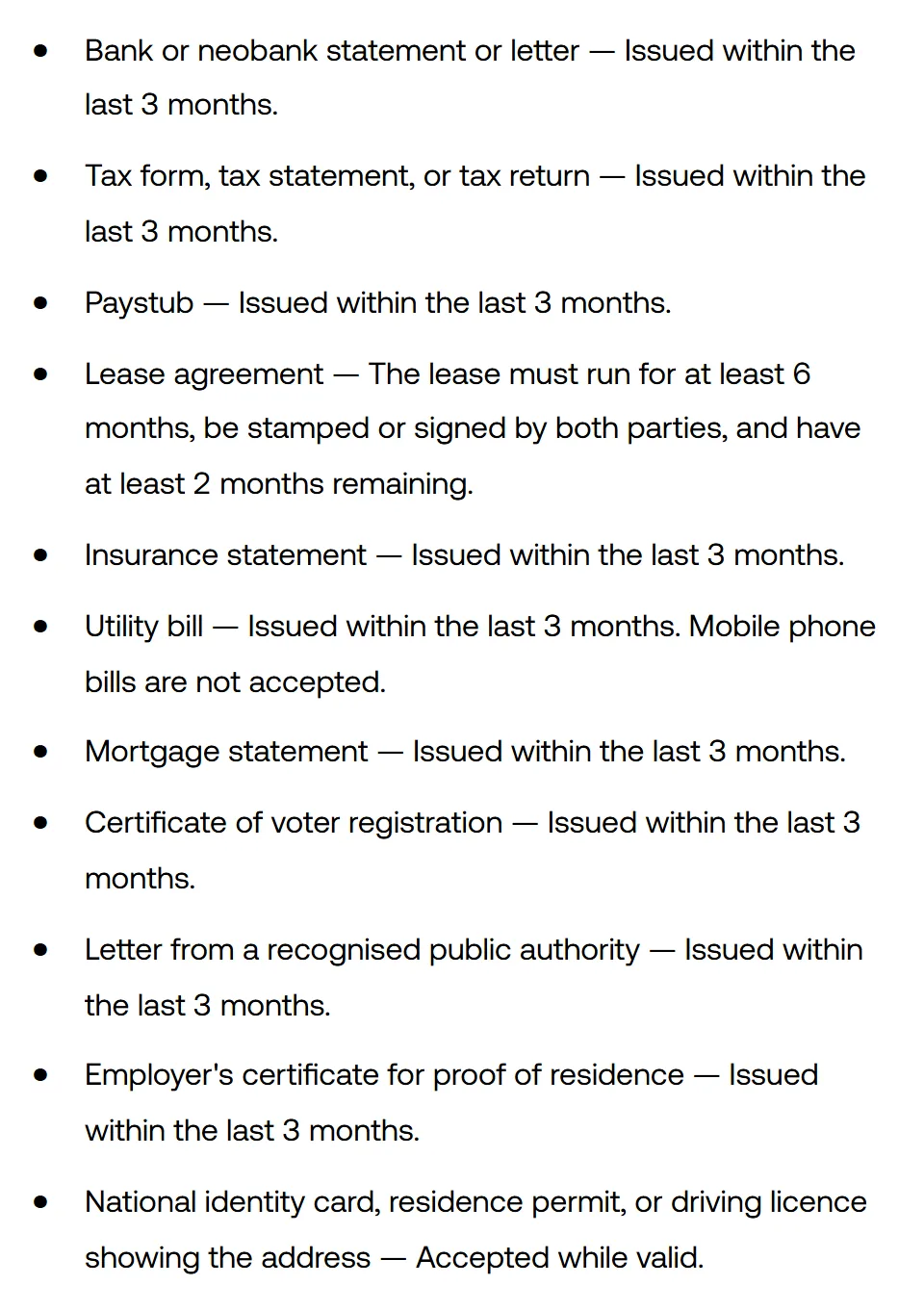
| Bank documents | Bank or credit card statement; a reference, address confirmation or balance letter, stamped and/or signed | Official bank statement; bank reference letter | Bank or neobank statement or letter | Records or statement from a financial institution | Bank statements; mortgage repayment documents |
| Utility bill | Yes, but not cut-off notices, payment reminders or payment schedules | Yes | Yes | Water, electricity, gas, internet | Water, gas, wifi and others |
| Government documents | Official correspondence; certificate of residence from local government | Residential proof or certificate of residence from government; tax returns; council tax bills | Letter from a recognised public authority; tax documents; voter registration certificate | Document from a government agency; residence certificate; tax document; voter registration letter | Any document from government bodies, including tax and voter registration documents |
| Lease or tenancy agreement | Government tenancy contract or registration certificate, valid within 1 year; university housing agreement; a private lease isn’t named | Lasting more than 6 months | At least 6 months long, stamped or signed by both parties, at least 2 months left | Signed by the landlord and the tenant | Listed, no conditions given |
| ID card showing your address | Yes, if it isn’t the document you used for identity | Yes, with your full name and full address | Accepted while valid | Not named on its address list | Listed with government documents |
| Payslip or employer letter | Payslips and labour contracts refused | Payslips not named; a company referral letter refused | Paystub; employer’s certificate for proof of residence | Payroll statement or employment document | Documents issued by employers |
| Mobile phone bill on its own | Refused, except in several jurisdictions it doesn’t name | Refused | Refused | Refused; landline and telecom package bills accepted | “telephone bills” listed, kind not stated |
| Insurance and medical papers | Home insurance only; medical bills refused | Insurance documents and medical bills refused | Insurance statement accepted | Insurance documents and medical documents accepted | Not named |
| P.O. box | Documents issued to one refused | Listed as not accepted, with a note that names one region | Not named | Not accepted from any country | Not named |
| Files and copies | PDF recommended, including a PDF of a paperless bill; colour screenshots or scans if the first page is clear and readable; no photocopies, and nothing blurred, reflective or black and white; .PDF, .JPG, .JPEG, .PNG | Failures page lists screenshots, scan copies and printed documents; asks for the original file or PDF | Original PDF or a clear image of the whole document; screenshots, scanned or printed copies listed as failures | JPG, PNG or PDF under 5MB; no password-protected files | A clear, complete image “with no cropped edges or glare” |
No bills in your own name?
A bill in a parent’s, partner’s or landlord’s name won’t do, whoever pays it. Address pages ask for a document issued in your name, and failure pages give another person’s name on the document as a reason a proof of address is invalid.
Going by the five lists, these are the documents most likely to be in your own name:
- Your own bank statement, or a letter from your bank. All five list bank documents, so we’d start here. Watch the exact name of the letter on the list: one accepts a “Bank Reference Letter” but refuses a “Bank or company referral letter”, so ask your bank for the document by the name the list uses.
- A letter from a government office. Every exchange in the table names at least one of tax documents, a voter registration letter or certificate, or a certificate of residence from your local authority.
- A lease in your name. Four exchanges take a private lease, and three of them set conditions: how long it runs, who signs it and how long is left. A short let, or one with only a few weeks left, can pass some of those rules and fail others. Pages can also disagree: an older failures page, last updated November 2025, lists tenancy agreements and ID cards as not accepted, the opposite of the same exchange’s FAQ updated in August 2026. That FAQ points you to “the supporting documentation guidance displayed on the verification page”, so go by what that page shows you.
- An ID card that shows your address. Four list it. At one of them it can’t be the same document you used for the identity step, in which case you’d need a passport or another ID for that step.
- Employer or university paperwork. Three exchanges list documents from your employer, and two of those also name a school, college or university as an issuer. Even where payslips are refused, a university housing agreement, a letter from a university confirming you study there and your current address, or a government student grant, loan or bursary letter sent to that address can still be on the list.
- Housing support. At least one list also includes a letter from an NGO or non-profit about temporary housing.
Two shortcuts fail on the rules themselves. Editing a bill is one of them, since the rules ask for “original, unedited documents only”, or for documents that are complete, official and unaltered. The other is ordinary post in place of an official letter. Asked whether a letter or package sent to you can be used, one exchange’s FAQ answers “No.”
If nothing on any list is in your name, ask the exchange’s support which document would cover your case before you upload anything. None of the five describes an exception process, or using someone else’s bill with or without that person’s permission, so the answer has to come from support.
How recent does proof of address need to be?
Three months is the rule at four of the five, but they don’t all count it from the same day. Each exchange’s wording tells you which day:
- “Issued within the last three months” counts from the issue date.
- “Dated within the last three months” counts from the date on the document, and the page that says it adds: “Documents older than three months will be rejected.”
- “Dated less than three months before the date of submission” counts back from the day you send it.
Binance also counts from the date of issue, but the length depends on your country of residence. Its table gives 6 months to every country it doesn’t name, “unless otherwise stated on the document (up to 1 year)”, and to a few it does; 3 months to a longer named list; and 2 months to one. Its upload notes only say “three or 6 months depending on jurisdiction”, so your country’s row in the table is the line to follow. Our proof of address date check works from that table. Pick your country and document type, enter the issue date, and it shows the last day the document still counts.
Some documents run on their own clock:
- ID cards. One three-month rule opens with “Except for the Proof of Identity”, and another exchange accepts an ID card, residence permit or driving licence showing your address for as long as it’s valid.
- Leases. One exchange tests a lease by its term instead of an issue date, asking for one at least 6 months long with at least 2 months left. The other three that take a private lease state no separate window for it, so their general date rule is the one written down.
- Two documents in that country table. A certificate of residence is “within 3 or 6 months, depending on the jurisdiction”, and a government tenancy contract is “valid within 1 year”.
If your document is close to its last valid day, we’d send a newer one. Binance says its address review “may take up to 1-2 working days”, and only one of the five ties the count to the day you submit, not the day someone reviews it.
The windows are as each exchange’s help-centre pages gave them in October 2026, and they change; if your upload screen asks for a more recent document, that’s the rule you’re under.
Name and address: the same as you typed them
Each exchange’s rules tie the document to what’s already on your account.
- Your name. Three of the five spell it out: your name “the same as the ID submitted”, a name that matches the one on your identity document, and the same name at both verification levels. None of them says how close is close enough if your bill leaves out a middle name, uses initials or orders your names differently. Our page on names spelt, ordered or changed differently from your ID covers each case, including a legal name change.
- Your address. Three also tie it to what you typed, in wording that runs from “must be the same as the residential address entered” to an address that “matches exactly” with the document. Where the form asks for your address, copy it as the document prints it, house or flat number and postcode included, rather than typing it from memory.
- A home address. Three exchanges refuse P.O. boxes, and at least one list also says “your residential address must be visible” and refuses mail forwarding and virtual office addresses. One of the three adds a note naming a single region without saying why, so check the current wording if you use a P.O. box.
As for why they want a home address at all, the two exchanges that give a reason both start with regulatory compliance, and add that the address helps keep your account, or the information on it, accurate and secure.
Outside the exchanges, the US National Institute of Standards and Technology’s identity-proofing guideline, SP 800-63A, gives a general reason. Among the fraud checks it recommends is a “Mailing address check”, which looks at whether the mailing address “is a known virtual Post Office (PO) Box or has other high-risk characteristics”.
Can you upload a PDF or a screenshot of a bill?
If the bill or statement reaches you online, we’d upload the PDF your provider issues rather than a photo of your screen. The pages that mention PDFs recommend the format or ask for the original PDF, and one accepts “a PDF file of a paperless bill” by name.
Photos, scans and screenshots are where the rules split:
- Colour copies accepted. One list takes colour screenshots and colour scans, as long as the first page is clearly visible and everything on it is readable, but turns down photocopies, and scans or screenshots that are blurred, reflective or in black and white.
- Originals only. Two exchanges’ failure pages list screenshots, scanned copies and printed copies among the reasons for refusal, and their fixes ask for the original document, as a colour photo or a PDF file. One of them also answers “No” when asked whether e-copies of identity documents can be used. Neither page says how that applies to a bill that only exists online, so read the instructions on the upload screen before you send a downloaded PDF there.
File types and size limits differ too, and one exchange caps uploads at 5MB. If your bank’s statement opens with a password, get a copy without one before you upload it, since that exchange turns password-protected files away.
Proof of address rejected, or you’ve moved?
Two exchanges’ failure pages have a section on an invalid proof of address. Both list another person’s name on the document and a document type they don’t accept, and both repeat the three-month rule beside them. One adds an address from a country restricted under its policies. Rejection messages vary, and the five headings that follow are ours rather than an exchange’s, so pick the one closest to yours:
- The type of document. Swap it for a type on that exchange’s accepted list. A better photo won’t change what kind of document it is.
- The date. Send a newer document, or a different type whose latest issue falls inside the window.
- The name. See no bills in your own name, or the name rules under name and address if the document is yours but written differently.
- The country. A different document doesn’t change where you live. If the address really is your home, the exchange’s terms are what apply. If you’ve moved, update the address with proof of the new one. To appeal the result on Bybit, submit a case support ticket.
- No reason, or the same file refused twice. Stop sending that file and send a different accepted type, ideally from another issuer. Bybit asks you to wait another 24 hours if your application has been denied more than five times within 24 hours. While a review is still running, uploading the documents again won’t help. If a second accepted document is refused as well, stop uploading and ask the exchange’s support which requirement it missed.
If your exchange sets the date window by country, why Binance rejects proof of address, and the fix for each reason has the upload steps, the 1–2 working day review and the appeal option in its privacy portal.
Moved since you were verified
A new home needs a new document, and each exchange handles the change in its own place:
- Bybit lets you update the address document without resetting your verification, once you’ve completed its Advanced level. After an update, you wait 180 days from your last submission before you can send another.
- Kraken sends you to its Change Account Info form: choose Address, then attach a valid proof of address for the new one.
- OKX says you can change the address on your account, and that you may need to provide an additional proof of address.
- Binance points you to [Modify Proof of Address] once you’re logged in; moving house has its steps.
The windows in how recent is recent enough apply to the new document too, and they count from the document’s date, not from the day you moved. If an exchange asks you to verify again after the move, what each verification level asks for, and why you may be asked again explains the requests that can follow.
Bank statements, other languages and travelling
Can a bank statement be proof of address?
Yes. All five exchanges compared here take bank documents: a statement on every list, and a reference or address confirmation letter on some. It has to be in your name, show the address you entered and be recent enough, which means within three months at four of the five and a window set by country at the other. Upload the PDF your bank issues rather than a photo of your screen, and if the file opens with a password, get a copy without one first.
Does the document need to be in English?
None of the five exchanges’ address pages asks for English. Two exchanges’ failure pages list a document in an unsupported language among the reasons for refusal, and ask for another document with Latin characters instead. Kraken says that for a proof of address in a language that uses non-Latin characters, a notarised translation “will greatly speed up processing time”, without saying the translation is required.
I’m travelling for a few months. Do I need a new proof of address?
Not for the trip itself, according to the two exchanges compared here that cover it. No update is needed to deposit or withdraw while you travel, and a short trip or temporary stay normally doesn’t count as a change of residence. If a travel or location prompt appears, answer based on where you actually live. A new address document is for an actual move.
The help pages compared
- Bybit
- Identity verification FAQ and guide, the page on verification failures, and the self-update guide — four pages. Identity verification FAQ (last updated 20 August 2026): accepted and refused proof of address documents, the three-month rule and its exception for identity documents, P.O. boxes, one name at Standard and Advanced, physical identity documents only, the guidance on the verification page. Verification failures (last updated 25 November 2025): reasons for an invalid proof of address, an older refused list that includes tenancy agreements and IDs, screenshots, scan copies and unsupported languages, more than five denials in 24 hours, appealing by support ticket. Verification guide (last updated 6 July 2026): proof of address processed only after Standard verification. Self-update guide (last updated 26 August 2026): updating the address document without resetting verification, the 180-day wait between address updates
- OKX
- Help-centre pages on proof of address documents, failed verification, verification basics and updating verified details — four pages. Proof of address documents (published 28 August 2026, updated 15 September 2026): accepted documents and their three-month dates, the lease conditions, IDs accepted while valid, mobile phone bills, uploading the original PDF or a clear image, matching what you entered. Failed verification (updated 25 August 2026): another person's name and unacceptable documents as reasons for an invalid proof of address, the three-month rule, screenshots, scanned or printed copies and unsupported languages. Beginner's guide (updated 25 August 2026): why a residential address is asked for, documents from an employer or a university or college, changing the address on your account, letters or packages sent to you. Updating verified details (updated 21 September 2026): short trips and temporary stays
- Kraken
- Support articles on document requirements, account information, verification help, level requirements and processing time — five articles. Document requirements (last updated 19 August 2026): name, address and a date less than three months before submission, P.O. boxes from any country, landline and package phone bills, valid documents (a list it says isn't limited to those named), translations, no password-protected files. Account information (last updated 3 September 2026): travelling compared with a new residence, the Change Account Info form for a new address. Verification help (last updated 26 February 2026): JPG, PNG and PDF files under 5MB, the entered address matching the document exactly. Level requirements (last updated 1 October 2026): the footnote on proof of address, in some countries a face photo instead when the address isn't confirmed automatically. Processing time (last updated 1 October 2026): uploading the documents again doesn't help a pending verification
- Binance
- Help-centre guide to verifying your residential address — the five required details, the validity table by country, accepted and refused documents, P.O. boxes, mail forwarding and virtual offices, original unedited documents, PDFs, screenshots, scans and file types, the 1–2 working day review, and Modify Proof of Address in its FAQ tab; updated 20 April 2026
- Bitget
- Help-centre guide to uploading proof of address — who may be asked for it and why, the three-month rule, the four document categories including telephone bills, leases and employer or school documents, name matching, a clear and complete image; published 12 February 2026, no later date shown
- NIST Special Publication 800-63A — the mailing address check among the fraud checks recommended for identity-proofing services; page stamped 26 August 2025