Is Crypto Exchange KYC Safe? What Happens to Your ID After You Upload It
A regulated exchange has to verify who you are, so the check is routine. The danger is the destination: upload only on your own account’s verification screens, never into a chat or a sent link.
Jump to a section
On an exchange’s own verification screens, your ID goes to the exchange and to the identity-verification companies it uses, and it stays on file after you close the account: five years or more on the notices that give a number. A deletion request can’t shorten what the law requires, and each privacy notice sets out who handles the files.
Who sees your ID, and how long exchanges keep it
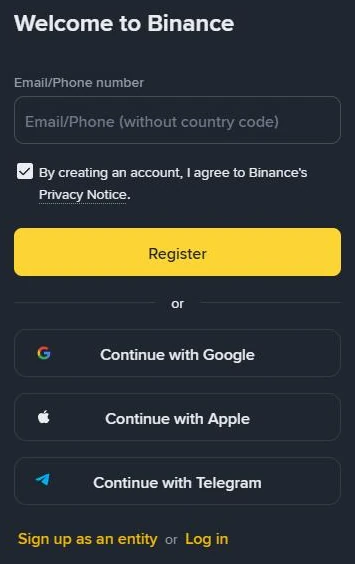
The privacy notice is the document that answers this, and you may accept it in a single line on the sign-up screen, as in the screenshot below.
Here is what five exchanges’ notices and help pages say about the ID you upload.
| Exchange | Who handles your ID images | How long ID records are kept | What a deletion request covers |
|---|---|---|---|
| Binance | Its automated checks and “the identity services selected by us”; for the extra check before its fiat services, the vendor depends on your country of residence, and that help page shows Onfido and Sumsub screens | Identity verification information is kept “for a specified period” set by legal and regulatory requirements; the privacy portal gives no number, and its account-closure page says the data is removed once the legal retention period expires | Personal data the law doesn’t require it to keep, such as marketing data |
| Kraken | The exchange plus third-party identity verification services; ID photos, selfies and videos “may be processed using technologies that extract biometric data” | Due diligence records for “a period (e.g., 5 years)” after the relationship ends, longer if it can’t delete them “for legal, regulatory, or technical reasons” | Deletion “in certain circumstances”, subject to the retention limits it must follow |
| OKX | Three named processors: Au10tix, Jumio and Sumsub | Only as long as the purpose or the law requires; erasure doesn’t apply where anti-money-laundering or sanctions law needs the data, with a 5-year minimum after the relationship ends | Data it no longer has a lawful basis to process |
| Bybit | Four named providers for ID and liveness checks (Sumsub, Onfido, Advance AI and ZOLOZ), plus a sanctions screening company | “For as long as necessary to fulfil the relevant purpose, and thereafter as required or permitted by applicable law”; no number of years | Deletion “where applicable”, except data it must keep for legal, accounting or tax reasons |
| Bitget | “Identity verification agencies” and fraud or crime prevention agencies, none named | At least seven years after the relationship ends, under Seychelles anti-money-laundering law; some records up to ten years if a dispute may arise | Erasure on request, though it “may not always be able to comply” for legal reasons |
The table follows the five exchanges’ privacy notices and help pages, as we read them in October 2026. Notices change, and one of the five was updated on 21 October 2026, so open the current version in the app or on the website before you rely on a figure.
A few things hold for all five:
- Your ID may pass through a verification company as well as the exchange. Two of the five name their providers in the notice, and the rest describe identity services, agencies or third parties without naming them. The vendor can also depend on the country you live in.
- The records outlast the account. In the UK, FCG 3.2.11 says firms “must keep copies of any documents and information obtained to meet CDD requirements” for five years after the business relationship ends. The same paragraph says the regulations require that data to be deleted after those periods, and that personal data collected under them should only be processed to prevent money laundering or terrorist financing. Other countries set their own periods, such as the seven-year minimum one exchange cites under Seychelles law.
- “Delete my data” has a legal floor. All five accept deletion requests in some cases and keep whatever the law makes them keep. Closing the account doesn’t change that, and two closure pages add a wait of 30 days or longer before the same ID can go on a new account.
Three of these exchanges describe software making the first call on your photos, and each describes a way to get a person to look again: self-service appeal options in the app or on the website that pass the case to KYC support staff for a manual review, human review that’s “Mandatory before final decision” when an automated identity check could delay, restrict or decline an account’s activation, or a request for a person to review the decision or contest it. If an automated check has got you wrong, that’s what to ask for.
The software can be wrong in ordinary ways. Binance’s privacy portal says its automated KYC checks aren’t perfect, and gives the example of twins opening separate accounts who are read as one person with two accounts.
Your data can also leave the country. Two of the notices place the exchange’s own processing in Seychelles and describe sending data abroad, either to verification providers in the UK and Singapore, which keep a copy of your document, your photograph and biometrics “Until cessation of agreement or earlier if requested”, or under adequacy decisions and safeguards such as standard contractual clauses. Refusing the overseas transfer, one of them says, means you can’t use the service. Two other promises appear in the notices: sensitive personal data encrypted in transit and at rest, and no sale of your personal data to third parties for their own commercial use.
Asking for a copy of your data, or for it to be deleted
Send the request to a contact point printed in a privacy notice you opened yourself, not one quoted in a message, and expect to prove who you are first. Two of the notices say they verify your identity before acting, one adding that it may refuse a request when it can’t, and those two are also the ones that set out the process in detail.
On Bybit, the notice lists access and portability, meaning certain data you gave it “in a structured, commonly used, machine-readable format”, requested through your account settings where available or through its support and data protection officer addresses. It accepts erasure requests, with legal exceptions, and promises a reply “within a reasonable period of time, but no later than the time period required by law.”
On Bitget, you can export an account ownership PDF from the website (not the app) with your KYC information and ID number, and the help page asks you to keep that file secure. Its notice accepts erasure requests with legal exceptions too, and its closure page says verified identity information is permanently deleted when you close, in line with that privacy policy and the regulations that apply; the policy is where its seven-year retention rule sits. After closing, you wait 30 days before registering again with the same mobile number, email address or ID. The notice aims to answer within one month of verifying you, extendable by up to two months where needed, and charges no fee unless a request is manifestly unfounded or excessive. For complaints it names the Information Commission of Seychelles or your local data protection authority.
Why do crypto exchanges need KYC?
The requirement comes from anti-money-laundering law. The UK Financial Conduct Authority’s Financial Crime Guide opens its customer due diligence section (FCG 3.2.4, dated 29 November 2024) with the line “Firms must identify their customers and, where applicable, their beneficial owners, and then verify their identities.” Where a firm can’t carry out those checks, the guide says “it must not enter into, or continue, the business relationship.” In the US, FinCEN’s Customer Due Diligence Rule puts “identify and verify the identity of customers” first among its four core requirements. Its page lists the US firms the rule covers, from banks and mutual funds to securities brokers. So the rule doesn’t reach every exchange everywhere, but the idea behind that first requirement is the same.
The exchanges’ own notices give the same reason. Four of the five tie identity checks to the law, whether they cite Know Your Customer and customer due diligence rules, “Compliance with a legal obligation”, anti-money-laundering and counter-terrorism financing laws, or anti-money-laundering regulations worldwide as the reason automated checks run on the documents, photo and live video you send. Two of the five require verification before you can use their products, deposits and trading included. The detail is in what each verification level asks for and opens, and the ID documents exchanges accept helps you pick one.
The same FCA section says an electronic ID check can count as a reliable source when the process is “independent of the person whose identity is being verified, secure from fraud and misuse” and gives enough assurance that you are who you say you are. We’d hold any upload screen you’re shown to that test. It should be the firm’s own process, with nobody standing in between.
Exchanges’ own FAQs answer this question too. Binance’s does it in two sentences: completing verification is safe, it says, and “Your documents are also confidential with us.” That’s the exchange vouching for itself, though. We’d put more weight on the privacy notices, because they’re where the detail is written down.
Three checks before each upload
A privacy notice binds the exchange, not someone copying its request, so run three checks before each upload:
- You started from your own account. Begin the upload from the account you’re signed in to, not from a link in a text, an email, a direct message or an ad. Account matters are handled inside the exchange’s own app or website, not through a link someone sends you.
- The same request is waiting when you sign in on your own. Kraken’s help centre says, “A genuine request will always be visible on your account after you log in.” So if someone contacted you about verification and your account shows nothing, treat the message as suspicious.
- The photos go into the verification screens, not into a conversation. That rules out a support agent in a messaging app, an admin on Telegram and a reply to an email. OKX’s FAQ puts it in one line, “Do not submit sensitive identity documents in ordinary chat.”
Not sure whether an email address, phone number or account that contacted you belongs to the exchange? Look it up with the exchange’s own checker where it has one. Not every exchange does, so check which exchanges offer a lookup, and how each works. If a check fails and the photos have already gone, go straight to what to do after sending your ID to a fake.
Never send your ID or codes by chat, email or Telegram
The three checks all point your ID to the verification screens inside your own account. Keep these out of any chat, email or message thread, however official the other side looks:
- ID photos and selfies, including a photo of you holding the document.
- Your password, 2FA codes, recovery phrase, and any money or crypto. The exchanges’ own help pages list these among the things genuine staff never ask for. There’s more in what genuine support never needs from you, page by page.
An offer to pass verification for you, or to sell you an account that’s already verified, asks you to break the exchanges’ own rules. One identity FAQ says it plainly: you can’t transfer your account to another person or substitute another person’s ID for your own.
Sent your ID to a fake site or a chat?
Work out what went with it, then take these in order:
- End the conversation. Send nothing more: no second photo, no selfie, no code, no payment.
- If a password or a code went too, secure the account first. Open the real app yourself and follow the steps for a password or 2FA code you gave away.
- Tell the exchange whose name was used, from inside its app or website. If you believe someone has used your identity document to verify an account, contact customer support; you may be asked to complete a live facial check, provide a valid identity document and explain why you believe the linked account isn’t yours.
- Keep the messages and the fake site’s address, so you can show support what you sent and where.
In the US, the Federal Trade Commission’s page “What To Do if You Were Scammed” (June 2026) says to report a scammer at ReportFraud.ftc.gov, and to go to IdentityTheft.gov if a scammer used your Social Security number. Neither the FTC page nor the exchange pages we read list a scam-reporting service for other countries. For reporting a passport or driving licence to its issuer, see the breach steps.
If you later verify your own account and are told the ID is already linked to another one, that’s the situation step 3 is for. For Binance’s version of that message, see an “ID number has been used” message for an account you never opened.
If an exchange tells you your data was in a breach
Check that the message is real first. The UK Information Commissioner’s Office warns that “criminals can use information from data breaches to impersonate trusted organisations”, so look for the same notice inside your account rather than following a link in the email. A breach message that asks for a new ID photo or selfie through a link or a chat fails the same three checks as any other upload request.
One notice says that after a personal data breach it will “notify the competent Data Protection Authority and affected individuals without undue delay” where the law requires it. Once you know the message is genuine, take the steps that match what was exposed.
- Ask the exchange what happened. The ICO says you can ask what information was affected and what the organisation plans to do to protect it. In the UK it has 30 days to acknowledge your complaint. Keep a record of each contact.
- If a login was exposed, change that password and the same password anywhere else you use it, and consider two-factor authentication, as IdentityTheft.gov advises.
- If your ID document was exposed, check what its issuer advises. The ICO’s steps after a breach include reporting lost or stolen passports and driving licences to whoever issued them. For US documents, IdentityTheft.gov says to report driving licence details to the nearest DMV branch and a lost or stolen passport to the State Department.
- Watch your bank statements and credit report. In the US, IdentityTheft.gov adds a free credit freeze and a free one-year fraud alert. In the UK, the ICO mentions Cifas protective registration, for a fee.
- If the exchange’s answer doesn’t settle it, the ICO takes UK complaints, and recommends letting the organisation investigate and respond first. Elsewhere, look in the exchange’s privacy notice for the authority it names.
Covering part of your ID, and what happens to the selfie
Can I cover my ID number or blur part of the photo?
Not according to the exchanges’ ID photo pages, which ask for the whole original: all the information on the ID clearly legible, photos that ‘show all corners of the ID card or document’, and the physical document itself rather than a screenshot, another photo, a photocopy, an e-copy or a scan. Neither of the two pages we compared describes covering any part of the ID. Bitget does let you mask details that aren’t needed on source-of-funds paperwork, but that’s a separate upload with its own rules.
Does the exchange keep a scan of my face?
All five privacy notices describe using face data to match you to your ID, but none gives a separate number of years for the face data taken during verification, and biometrics can fall under the same retention rule as your ID documents. Three of the five tie face data to your consent: collected with your consent or where local law permits, collected only after explicit consent at sign-up, or processed as special category data on grounds such as your explicit consent. One says you may withdraw your consent at any time by contacting the exchange, and OKX’s warns that deleting that data before verification is complete may affect your access to some services.
Privacy notices, help pages and guidance
- Binance
- Privacy portal and notice, and help-centre pages on verification, phishing texts, closing an account and checking official contacts — seven pages. Privacy portal (no date shown): automated decisions in KYC, the twins example and the self-service appeals, identity verification data kept for a specified period, what a deletion request covers, copies of your data and KYC information. Privacy notice (last updated 17 July 2026): biometric data used to compare your selfie or video with your ID photo, withdrawing consent, identity services selected by the exchange. Identity verification guide (updated 5 June 2026): verification required before using its products, deposits and trading included, the 'Is identity verification safe?' answer, and no transferring your account or using someone else's ID. Extra check before fiat services (updated 19 December 2025): different verification vendors depending on your country of residence, with Onfido and Sumsub screens. Anti-phishing code page (updated 7 February 2026): account issues handled only through the app or website. Closing an account (updated 3 September 2026): personal data kept after closure for as long as laws such as anti-money-laundering rules require and removed when that period expires, and a possible block of 30 days or longer on verifying a new account. Official contact lookup (no date shown): no requests for funds or tokens via private communications
- Kraken
- Privacy notice, and the support article on answering a request for more information — privacy notice (last updated 21 October 2026): verification information and biometric processing, the KYC legal basis, third-party identity verification services, retention after the relationship ends, your rights to access and erasure. Support article (last updated 1 October 2026): genuine requests visible after you log in, and what it never asks for
- OKX
- Privacy notice, and help-centre pages on an identity linked to another account and on ID and selfie photos — privacy notice (published 19 March 2024, last updated 1 July 2026): named identity verification processors, consent before biometric collection, human review before a final KYC decision, no sale of personal data, the retention schedule and the limits on erasure and access. Linked identity FAQ (published 28 August 2026, updated 2 September 2026): no identity documents in ordinary chat, and what to do if someone used your identity document. Photo guide (published 13 October 2023, updated 25 August 2026): original documents in colour, all information legible and all corners showing
- Bybit
- Privacy policy and identity verification FAQ — privacy policy of its operating company (effective 17 April 2026, page last updated 20 April 2026): retention of KYC documents and biometrics, KYC processing under anti-money-laundering law, the four identity verification providers with their countries and retention, sanctions screening, processing in Seychelles, rights to access, deletion and portability and their limits, identity checks before a request and the data protection officer. Identity verification FAQ (last updated 20 August 2026): verification required for all its products and services, physical documents only, no e-copies or scans
- Bitget
- Privacy notice, and help-centre pages on closing an account, exporting account data and enhanced due diligence — privacy notice (last updated 5 December 2025): identity verification agencies, the image of your face as special category data, anti-money-laundering checks under a legal obligation, automated decisions and human review, transfers out of Seychelles, encryption, what it does after a breach, the seven-year and ten-year retention periods, your rights and their limits, identity checks before a request, fees, the one-month reply and complaints. Closing an account, website guide (published 29 March 2024): verified identity information deleted on closure in line with the privacy policy and regulations, and the 30-day wait before a new account with the same ID. Exporting account data (published 14 March 2025): the account ownership statement with KYC information and your ID number, on the website only. Enhanced due diligence questions (published 27 January 2026): redacting details that aren't needed on source-of-funds documents
- FinCEN
- CDD Final Rule — the four core customer due diligence requirements and the US firms they cover; no date shown
- UK Financial Conduct Authority: FCG 3.2 Themes — customer due diligence (FCG 3.2.4, dated 29 November 2024), reliable electronic identification, and record keeping for five years after the relationship ends (FCG 3.2.11, dated 13 December 2018); last updated 29 November 2024
- FTC: What To Do if You Were Scammed — US consumer advice: reporting a scammer and a misused Social Security number; June 2026
- ICO: What steps can I take if I’ve been affected by a personal data breach? — UK advice: what to ask the organisation, the 30-day acknowledgement, impersonation after a breach, reporting lost or stolen passports and driving licences to the issuer, bank statements and credit reports, Cifas protective registration, complaining to the ICO; no date shown
- IdentityTheft.gov: What To Do if Your Information Was Lost or Stolen, or Part of a Data Breach — US advice: credit reports, freezes and fraud alerts, credit monitoring, and the steps for a password, a driving licence or a passport; no date shown